

-
 Written by Ruban Selvanayagam
Ruban Selvanayagam
Written by Ruban Selvanayagam
Ruban Selvanayagam
Ruban Selvanayagam is a professional cash homebuyer, private rented sector landlord, auction specialist, blogger and media commentator.
-
Edited by James Durr
James Durr
James Durr is a passionate property entrepreneur with a strong foundation and background in business.


Key Takeaways
- The short answer is “no”. Whilst, in theory, it’s possible to secure mortgage finance against a property sold at a traditional (28 day) auction, the chances of getting it approved and completed on time are pretty much zero.
- Although specialist arrangements such as “hunter’s licence” facilities do exist, they are typically used by experienced investors and usually require the lender to have reviewed the property well before the auction.
- If you intend to rely on a conventional mortgage, buying through Modern Method of Auction is the better option. The longer completion period gives lenders sufficient time to carry out valuation approvals, underwriting and legal due diligence.
- Most professional auction buyers instead use a staged approach: acquire the property using cash or bridging finance, refurbish or resolve any legal issues, remortgage and either rent (also known as BRRR) or sell the property.
- Above all, success at auction comes from preparation. Understanding the property’s condition, legal position, financing options and exit strategy before bidding is far more important than trying to arrange a mortgage after the hammer has fallen.
If you prefer to watch rather than read, check out the video below where I explain the key concepts covered in this article…
Why Securing a Mortgage for an Auction Purchase is Practically Impossible
After more than 20 years in the quick sale industry, we can confidently say that mainstream mortgage funding is far too slow to meet traditional auction deadlines.
At auction, following 3 to 4 weeks of active marketing, the exchange of contracts happens the moment the hammer falls.
A 10% deposit, alongside any fees owed to the auctioneer, is due immediately. Buyers are then legally committed to the purchase, with the full balance typically due within 28 days. The financial penalties for not completing are highly punitive.
This creates a clear mismatch between traditional auction deadlines and mortgage approval timescales, which can often take months from application through to completion.
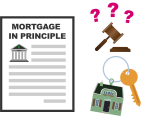
Remember that a Mortgage in Principle (MIP) or Decision in Principle (DIP) is not a guarantee that the loan will be approved. Relying on MIP or DIP when bidding at auction is highly risky, especially if you have no other funds to complete on the sale.
Traditional Auctions vs. Modern Method Auctions: Which Works Better with a Mortgage?
Although traditional auctions remain the dominant sales format, modern method auctions operate somewhat differently – especially from a mortgage lender’s perspective.
Traditional (Unconditional) Property Auction

Here, as explained above, exchange of contracts occurs when the hammer (or “gavel”) falls, with completion legally required within 28 days.This makes securing mortgage finance a practical impossibility, as lenders need to conduct valuation checks, underwriting and legal due diligence before exchange.
It’s also worth remembering that lenders can (and often do) withdraw or adjust their offer after the survey or reviewing key aspects of the transaction.

The “6-month rule” is another important consideration. Under UK Finance (formerly the Council of Mortgage Lenders) guidance, many lenders will not lend against a property that has changed ownership within the previous six months.
Some argue it may be possible to reduce the risk by arranging an independent Royal Institute of Chartered Surveyors (RICS) valuation before bidding.
However, in our view, this is very risky, particularly as there’s no guarantee that you’ll win the auction, nor that the lender will exclusively rely on the RICS report, nor raise other concerns later in the process.
There is also the remote possibility of being able to extend the completion date after the hammer falls, perhaps if demand for the property has been low.
Whilst potentially feasible, this tends to run contrary to the ethos of a traditional auction sale, generally looked at with scepticism by sellers and something we wouldn’t recommend accepting to our clients here at Property Solvers Auctions.
Modern Method of Auction or MMoA (Conditional Auction)

Whilst by no means full proof, MMoA is a much more mortgage-friendly route.
The winning bidder pays a reservation fee and is given an exclusivity period – typically 28 days to exchange contracts, followed by a further 28 days to complete.
That 56-day window is usually enough time to arrange a standard mortgage, carry out a survey and instruct solicitors properly.
The Best Way to Mortgage an Auction Property
At Property Solvers Auctions, we would very rarely accept standard mortgage buyers to participate in a traditional 28-day auction transaction.
In reality, most experienced auction buyers follow a BRRR strategy – Buy, Refurbish, Refinance and Rent. The key point is that the mortgage is often arranged after the auction purchase has completed, not before.
Let’s run through the process…
Buy with Cash or a Bridging Loan First

The first stage is to get the auction purchase completed within the contractual timeframe using cash or, more commonly, “flash” funding.
Auction bridging loans are short-term secured loans specifically designed for transactions where speed matters. They are widely used within the auction sector because funds can be arranged within weeks rather than months.
They also allow buyers to purchase properties that standard mortgage lenders would immediately decline to finance.
This often includes properties with structural issues, short leases, heavy refurbishment requirements, non-standard construction, legal complications or anything else considered unsuitable security by mainstream lenders.
Typical bridging loans involve monthly interest rates of around 0.5% to 1.5%, alongside arrangement + exit fees and loan terms usually ranging between 3 and 24 months. Whilst expensive compared to standard mortgages, they can be highly effective when used correctly.
There are some experienced investors that utilise specialist “hunter’s licence” facilities, where quickly accessible capital is secured against unencumbered or low-leverage properties.
Refurbish

Once the purchase has completed, the next stage is usually to resolve whatever issues prevented the property from qualifying for mainstream mortgage lending in the first place.
This often involves replacing kitchens and bathrooms, upgrading gas central heating and electrics, carrying out structural repairs or simply modernising the property to a standard acceptable to lenders and future tenants.
In other cases, the work is more of a legal or “paper” exercise – extending short leases, resolving title defects, removing restrictions, regularising planning or building regulation issues, updating tenancy agreements or correcting ownership discrepancies
The aim is to make the property genuinely mortgageable whilst also increasing its value and rental potential.
Refinance

Once the property has been refurbished, stabilised or brought up to lender standards, the next stage is usually refinancing onto a longer-term buy-to-let mortgage with lower borrowing costs.
At this stage, it’s sensible to explore what’s available through a good “whole of market” buy-to-let mortgage broker.
If the property has increased in value following the improvements, refinancing may also release some of the uplifted equity for future projects – although this will depend on lender criteria, valuation, survey results and the overall structure of the deal.
There are also bridge-to-let products available, where the bridging and refinance stages are effectively combined. However, in our experience, separating the two finance processes often provides greater flexibility and can prove more cost-effective overall.
Rent

Once refinanced, many investors will retain the property as an income-producing asset.
Despite the increasingly negative sentiment surrounding the buy-to-let sector, rents have continued rising across many parts of the UK due to limited supply and affordability pressures within the owner occupier market.
The key, however, is ensuring the numbers still work properly after mortgage costs, maintenance, compliance obligations, void periods and taxation are fully taken into account.
How Professional Property Buyers Finance Auction Properties for Maximum Profit
Below is a simplified step-by-step overview of how experienced auction buyers typically approach the process.
Step 1 – Identify the Right Type of Property

The initial focus is to seek out below market value properties with clear value-add potential.
These include refurbishment opportunities, short leases, probate, problem tenancies, planning gain, development opportunities, title or other complex ownership situations.
AUCTION BUYER / PROPERTY INVESTOR PROFILING
Step 2 – Download and Review the Auction Legal Pack

Experienced buyers will scour the auction legal pack before bidding.
This can include the title documents, special conditions, lease details, searches (where available) with a fine tooth comb to identify anything that could affect refinancing.
Taking into account the inherent built-in biases, it’s well worth running the pack through your AI tool of choice.
Should anything remain unclear or potentially problematic, instructing an experienced auction conveyancer to review the documentation can be money well spent.
Step 3 – View the Property Properly and Understand the Underlying Issues

Physically inspecting the property before bidding is always a wise idea.
The aim is to assess the condition, likely refurbishment costs and whether the property could realistically become mortgageable after improvement works.
Arranging a full RICS survey before every auction purchase is often impractical and expensive. Instead, many buyers will bring along a trusted builder, contractor or tradesperson to help identify structural issues, damp, roof problems, outdated services and the likely cost of remedial works.
Step 4 – Assess Eventual Mortgageability

It’s fairly common to see unmortgageable properties at auction.
Common issues include severe disrepair, missing kitchens or bathrooms, structural movement, non-standard construction, legal restriction and short leases.
The key is understanding not only what the problems are, but also the likely full cost, complexity and timeframe involved in resolving them before the property becomes acceptable to mainstream mortgage lenders.
Step 5 – Plan Your Exit Strategy

Professional buyers should know their exit strategy before the bidding even starts.
For some, the plan is to refurbish and refinance onto a buy-to-let mortgage (as discussed above). Others may improve the property and sell it on at a profit (i.e. “flip”) instead.
Although a sign of poor auctioneering practice, some traders also target auction “arbitrage” opportunities. This involves buying underexposed lots from one auctioneer before reselling them for profit through another with better marketing.
Step 6 – Arrange Your Auction Finance Upfront

As discussed above, it’s crucial to arrange cash, private funding or bridging funding before the auction begins.
This gives certainty that the transaction can be completed on time and avoids the financial penalties should the relevant auction deadlines not be met.
Step 7 – Start Conversations with Mortgage Lenders via a Broker

Experienced investors will often begin discussions with specialist mortgage brokers and lenders before bidding even starts.
The aim is to understand what the refinance or long-term lending position could realistically look like once the property has been improved or stabilised.
Over time, focusing on building a strong network of brokers, lenders and finance professional should be a key objective. Keeping track of changing mortgage criteria, rates, lending appetite and the myriad of macro factors will all help secure the most effective exit strategy possible.
Step 8 – Ensure Your Deposit and Fees Are Ready

Traditional auctions normally require a 10% deposit immediately when the hammer falls.
Buyers also need to budget for auctioneer fees, legal costs, bridging arrangement fees and, in many cases, the higher rate Stamp Duty Land Tax surcharge applicable to additional property purchases.
Step 9 – Set a Maximum Bid and Stick to It

Professional buyers will usually reverse engineer the deal before bidding even starts – working backwards from the refinance values minus refurbishment costs, finance and a range of other overheads involved to calculate their maximum bid.
One of the fastest ways to lose money at auction is getting caught up in emotion or FOMO once bidding starts. To avoid falling into this trap, use proxy bidding or leave strict bidding limits in advance to avoid overpaying in the heat of the moment.
Step 10 – Exchange Contracts Immediately (at the Fall of the Auction Hammer)

At a traditional auction, exchange of contracts happens instantly once the auction closes successfully. This means that you will usually have to transfer the 10% deposit into the auctioneer’s client account.
At Property Solvers Auctions, buyers have 24 hours for the funds to appear in our client account (but most transfer immediately).
Step 11 – Complete Within the Auction Deadline

Completion is usually required within 28 days, although some auction contracts may differ slightly. For example. 42 days is not unheard of for commercial and mixed-use property sales.
This is why fast-access funding is so important within the auction market. Failure to complete on time can result in losing your deposit and incurring “abortive” financial penalties.
Step 12 – Refurbish or Resolve Other Problems (Legal or Otherwise)

After completion, resolving whatever issues prevented mainstream mortgage lending becomes paramount. This often involves refurbishment works, structural repairs and modernisation.
Here it becomes crucial to closely monitor refurbishment costs, timescales and other holding costs during this stage. Unnecessary delays can quickly erode profit margins – particularly when expensive short-term finance is involved.
The focus may be also on resolving legal or title related issues with a good conveyancing solicitor. This can include extending a short lease, removing restrictions, regularising planning or building regulation matters, or addressing other defects highlighted within the legal pack.
13. Refinance Onto Longer Term Buy to Let Finance (and Rent)

Once the property becomes mortgageable, investors can then refinance on to a standard buy-to-let mortgage with lower long-term borrowing costs and rent the property out.
Investors will then typically choose between fixed-rate or tracker mortgages depending on their appetite for certainty versus flexibility. The right option will usually depend on interest rate expectations, cash flow requirements and the investor’s longer-term strategy.
14. Sell the Property

Other investors may choose to sell the property – typically on the open market – and recycle the capital into future projects. Selling some and retaining others can also be a wise strategy.
If the refurbishment and repositioning have been done properly, the aim should be to bring a high-quality product to market that stands out from competing listings.
Before selling, it is important to understand the tax implications – whether that involves Capital Gains Tax (for properties owned in your personal name) or Corporation Tax (for those owned in a corporate structure).
Certain HMRC allowances, improvement and finance costs may potentially be offset, so good accounting advice is a must.
Frequently Asked Questions
Yes, but only if the seller agrees.
Whilst some sellers may accept a higher offer in return for a longer completion period, many choose the traditional auction route specifically because they value speed, certainty and fixed contractual deadlines.
That said, if a property has attracted limited interest, the seller may be more open to negotiating.
Before increasing your offer, however, ask yourself whether paying more really makes commercial sense or whether there are better opportunities elsewhere.
A common mistake auction buyers make is becoming emotionally attached to a single property.


